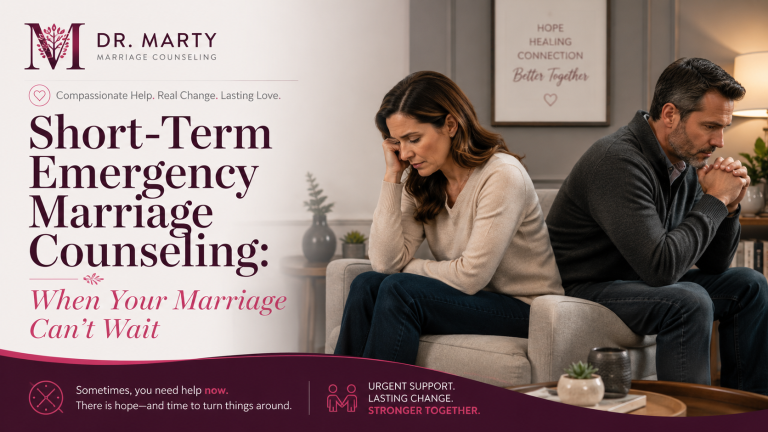
Some marriages don’t have the luxury of time.
A discovery of infidelity. A sudden threat of separation. An affair partner who’s just been confronted. A spouse who has one foot out the door and a moving truck already reserved. In moments like these, the standard model of “let’s meet weekly and work through this over the next year” isn’t just inadequate — it can be dangerous. By the time a couple gets to session four, the marriage they were hoping to save may already be over.
That’s the gap Short-Term Emergency Marriage Counseling (STEMC) is built to fill.
What Is Short-Term Emergency Marriage Counseling?
STEMC is a focused, intensive form of couples intervention designed for crisis moments — not general relationship maintenance. Rather than the traditional 50-minute weekly session, STEMC compresses the work into a small number of high-intensity sessions, often scheduled within days of the initial call, sometimes meeting multiple times in a single week.
The goal isn’t to resolve every underlying issue in the marriage. The goal is to stabilize the crisis, interrupt the cycle that’s driving the couple toward an irreversible decision, and buy the time and clarity needed to make a real choice about the relationship’s future — rather than a reactive one made in panic, humiliation, or rage.
In my 35+ years running a couples and marriage practice, drawing on the Gottman Method and Emotionally Focused Therapy (EFT), I’ve found that certain situations call for this kind of rapid, structured intervention:
- Discovery of an affair within the last 1–2 weeks
- One spouse has announced they’re leaving and has already taken concrete steps (an attorney, an apartment, a moving date)
- A blow-up event — a public humiliation, a financial betrayal uncovered, a health crisis — that has destabilized the relationship overnight
- A couple standing at a genuine fork in the road: divorce, separation, or recommitment, and they need clarity fast
STEMC draws heavily on discernment counseling principles (William Doherty’s model) in its early phase — because before a couple can do the deeper repair work, they often need to agree on whether they’re even trying to repair the marriage, or preparing to end it. That clarity alone can be the difference between a couple that spirals for another six months and one that either recommits with real direction or separates with dignity instead of destruction.
Why Timing Matters More Than People Realize
Most couples wait an average of six years after problems begin before seeking help. By the time they arrive in a therapist’s office, contempt has often set in — which, per Gottman’s research, is the single strongest predictor of divorce. In an emergency, that timeline compresses even further: a couple in acute crisis may have days, not years, before a decision becomes irreversible.
The private-pay model I use allows for this kind of responsiveness. There’s no waiting for insurance authorization, no diagnostic code required to justify “medical necessity,” and no fixed 45-minute session length dictating the pace of the work. For the executives, physicians, and attorneys I typically work with, this also means complete confidentiality — no claims filed, no records shared with an employer’s benefits administrator, no paper trail. In a moment of personal crisis, that privacy is often as valuable as the clinical work itself.
Two Illustrative Stories
The following vignettes are composites drawn from patterns common to this kind of work. Identifying details have been changed and no specific client is represented.
Story One: The 72-Hour Window
A physician called on a Tuesday evening. Her husband had discovered a series of text messages that morning, confronted her, and by that afternoon was already looking at short-term rentals. He wasn’t sleeping in the house that night. She was terrified the marriage was over before either of them had said more than a handful of words to each other.
We met the next morning — a joint session, followed by two individual sessions that same day, and a second joint session 48 hours later. The early work wasn’t about forgiveness or rebuilding trust; it was far too soon for that. It was about interrupting the spiral: helping him separate the urge to flee from the actual decision he wanted to make, and helping her tolerate his anger without either collapsing into shame-driven pleading or defensive counterattack — both of which tend to accelerate a spouse’s exit.
By the end of the week, he had agreed to stay in the house and commit to a 90-day discernment period rather than filing for divorce immediately. That didn’t mean the marriage was safe. It meant the decision was no longer being made at 11 p.m. in a state of shock — it was being made with information, structure, and a plan.
Story Two: The Blow-Up Before the Holidays
An attorney and his wife had a public argument at a family gathering that ended with her telling relatives, in front of their teenage children, that she wanted a divorce. Within 24 hours, both of them separately reached out, each convinced the marriage was unsalvageable and each humiliated in a different way.
Given the acute nature of the rupture — and the risk that the children would be pulled into an escalating conflict over the holiday — we scheduled three sessions across five days. The early focus was almost entirely on damage control: establishing a temporary communication protocol so they weren’t relitigating the blow-up by text at midnight, and separating the question “should we stay married” from the more urgent one, “how do we get through the next two weeks without doing more harm to each other or our kids.”
Once the acute crisis was contained, they were able to move into a slower, more traditional course of EFT-based work. The emergency phase didn’t save the marriage by itself — but it kept a bad moment from becoming an irreversible one, and it gave them the chance to find out, with a clearer head, what they actually wanted.
If You’re in the Middle of a Crisis Right Now
If your marriage is in an acute crisis — not a slow decline, but an active rupture — waiting weeks for a first appointment can cost you the very window in which the situation is still salvageable, or still endable with dignity.
I offer Short-Term Emergency Marriage Counseling for exactly these situations: rapid scheduling, intensive early sessions, and a clear, private-pay structure with no insurance involvement.
If you’re facing a marital emergency, reach out today Call 732-246-8484
